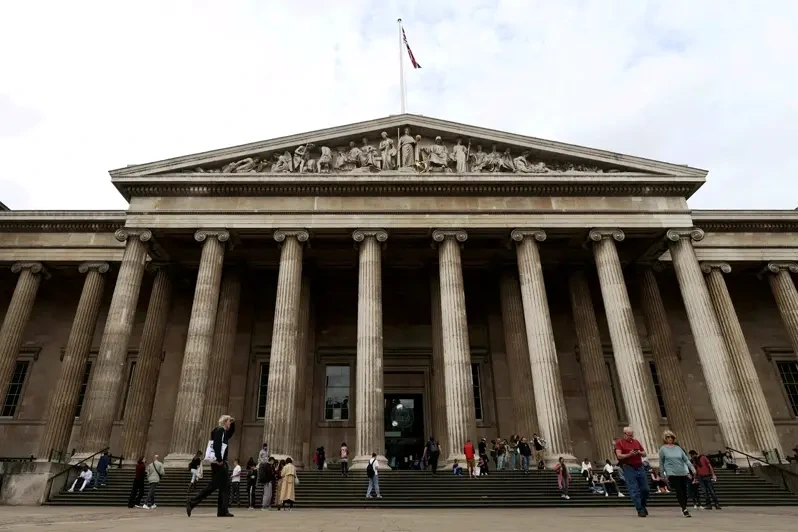
According to the South China Morning Post, two Chinese ceramic artifacts at the British Museum were accidentally damaged while on display and are currently undergoing restoration by a team of specialists. This incident has reignited discussions regarding the museum’s artifact preservation measures, focusing attention on the safe display of fragile cultural treasures.
The British Museum confirmed on Friday that an incident involving damage to artifacts occurred on October 4; a porcelain bowl fell from a display shelf and struck a small porcelain box on a lower shelf, damaging both items.
The museum stated, “Both artifacts have now been handed over to our specialist conservation team for full restoration.”
The museum noted that post-incident inspections revealed no signs of damage to the display shelving or the mounting bases, though the museum will continue to investigate the cause of the accident.
Photos circulating on social media show ceramic fragments scattered inside a four-tiered display cabinet. The items in the cabinet belong to the Sir Percival David Foundation of Chinese Art. Specifically, a porcelain bowl (catalog number B629), originally placed in the center of the top shelf, appears to have fallen to the bottom shelf, shattering another artifact (catalog number 634).
According to the British Museum’s website, both damaged ceramic pieces date back to the Kangxi reign of the Qing Dynasty (1662–1722) and originated in Jingdezhen, Jiangxi Province, China. The museum’s website has currently marked both artifacts as “not on display.”
The bowl cataloged as B629 is titled “Bowl with Ladies Engaged in the Four Accomplishments.” It measures 216 millimeters (approximately 8.5 inches) in diameter and 80 millimeters in height. This blue-and-white porcelain piece features underglaze blue designs depicting ladies in a garden setting engaged in various cultural activities—such as appreciating paintings, playing traditional stringed instruments, and playing board games—surrounded by attendants, trees, and mountains, creating an elegant garden scene. The British Museum described the porcelain bowl as “an exquisite piece imitating a 15th-century Ming Dynasty porcelain bowl.”
The other damaged artifact, cataloged as item 634, is a round porcelain box with a low, domed lid; it measures 66 millimeters in diameter and 25 millimeters in height. The center of the lid features a finely painted underglaze cobalt blue design of a Buddha’s hand citron, surrounded by peach branches and camellias, while the lower body of the box is decorated with peach branches and floral motifs.
Both artifacts were originally on display in Gallery 95 of the British Museum. Following the incident, the museum temporarily closed the gallery, reopening it the next day after staff had cleared the ceramic fragments from the display case.
Gallery 95 houses nearly 1,700 artifacts spanning the 3rd to the 20th centuries, comprising one of the world’s finest collections of Chinese ceramics. This collection was donated to the British Museum by the Sir Percival David Foundation of Chinese Art.
The incident sparked heated discussion on Chinese social media, drawing attention to how museums should better protect fragile cultural heritage.
Pan Jinyu, a Chinese-speaking tour guide based in London, posted on social media on Thursday: “More than the accident itself, I am concerned about why it happened, how the artifacts will be restored, and how similar incidents can be prevented in the future.”
Pan noted that the British Museum has previously attracted attention due to damaged or lost artifacts. She added, “What is even more disappointing than the damage to the artifacts themselves is that the mainstream British media has yet to report on this incident.”
Leave a Reply