Young protesters in France have brought elements from Japanese anime—such as One Piece and Porco Rosso—into the streets, using these characters and symbols to convey messages against oppression and fascism, and in pursuit of freedom. This has, however, drawn backlash from some Japanese internet users.
In recent waves of protests, many young French people have adopted characters and symbols from Japanese anime to voice their concerns. They find resonance in the themes of fearless freedom and defiance against authority present in works like One Piece and Porco Rosso; yet, this practice has sparked discontent among some Japanese netizens.
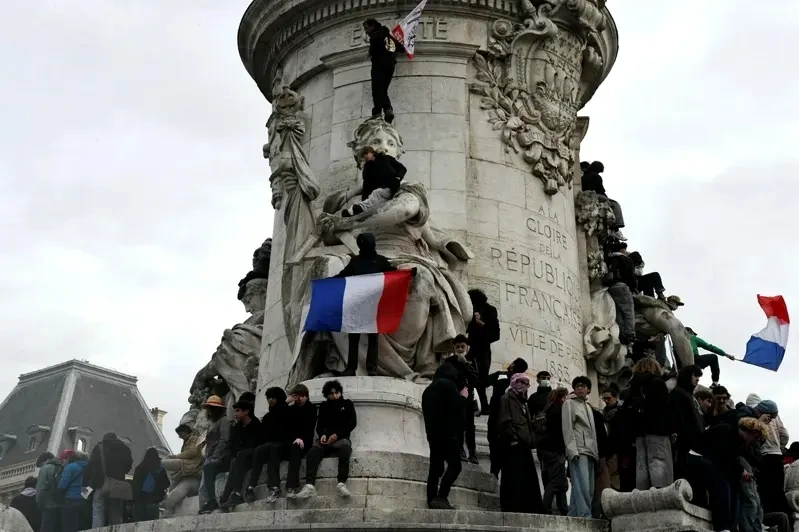
Since late September, French high school and university students have taken to the streets to demand better educational resources. Beginning in the suburbs of Paris, the movement has expanded into a nationwide protest. It has since forged alliances with major labor unions, retirees, and participants in the “Yellow Vests” (Gilets Jaunes) movement, evolving into a broad social campaign that addresses issues ranging from wages and purchasing power to public services.
During the demonstrations, many young people—influenced by Japanese pop culture—dressed up as characters such as Naruto, Goku from Dragon Ball, or Luffy from One Piece. Others incorporated anime imagery onto their placards to voice their sentiments; this stems partly from an identification with the personalities or choices of these characters, and partly from a desire to embody the same bold, spirited determination as these anime heroes.
Kehnwane, who is in his twenties, took a pirate flag—previously displayed in his room—and brought it to the protest. In an interview with a Central News Agency (CNA) reporter, he explained that many of his peers prefer to use symbols they have known since childhood to express their views; in the context of this movement, this particular flag has become the most prominent symbol.
The flag originates from the manga series One Piece, created by Japanese artist Eiichiro Oda. It features a white skull on a black background—the skull wears a straw hat adorned with a red ribbon, with two crossed white bones positioned behind it.
In recent years, this pirate flag has frequently appeared in protests led by young people around the world. According to Kehnwane, “The flag now represents the demand of young people to oppose oppression—regardless of whether that oppression stems from a monarchy or a republic.”
Within the ranks of the marchers, some waved the pirate flag, while others wore the iconic “Luffy hat”—a detail that allowed like-minded individuals to instantly recognize one another.
Ken-Wan is a devoted fan of the manga series One Piece—he reads every new volume as soon as it’s released—and even has a tattoo on his arm of the character Brook playing an instrument.
For Ken-Wan, the pirate flag symbolizes “the defense of freedom—the idea that everyone should be able to express themselves as they wish… Seeing it is like seeing freedom, or the promise of freedom to come.”
Some protesters are concerned that France is drifting toward far-right fascism. Another recurring figure from Japanese animation seen at the demonstrations is the protagonist of Hayao Miyazaki’s Porco Rosso; many protesters have depicted the pig—an ace pilot—on their placards, accompanied by the slogan: “Better to be a pig than a fascist.”
One demonstrator carrying a Porco Rosso sign told a reporter from the Central News Agency (CNA) that the phrase “perfectly captures our rational response to the fascist tendencies we are facing in France today.”
Another woman carried a placard featuring Ryomen Sukuna—a character from the series Jujutsu Kaisen—depicted in the midst of performing a hand seal. The text next to him was a slight play on the series’ signature technique, “Domain Expansion” (Ryōiki Tenkai), altered instead to “Rights Expansion.”
Young people in France occasionally draw upon anime characters for satirical purposes; for instance, some have portrayed political figures as Satoru Gojo—a powerful sorcerer from Jujutsu Kaisen—accompanied by the now-memorable, meme-ified line: “I’ll win.”
Such appropriations and reinterpretations reflect the affection and familiarity that young French people have for Japanese anime. However, some Japanese internet users have expressed dissatisfaction on social media, as they are uncomfortable with these works and characters being associated with the violence that erupted during the protests in France on the 17th of last month—an event during which several anime-themed shops in Paris were also looted.
Leave a Reply